
Roulette and the gambler’s fallacy: a number is not due
See why a streak does not change the next-spin probability in an independent fair-wheel model, with conditional probability and sequence examples.
Separate a surprising history from the next outcome
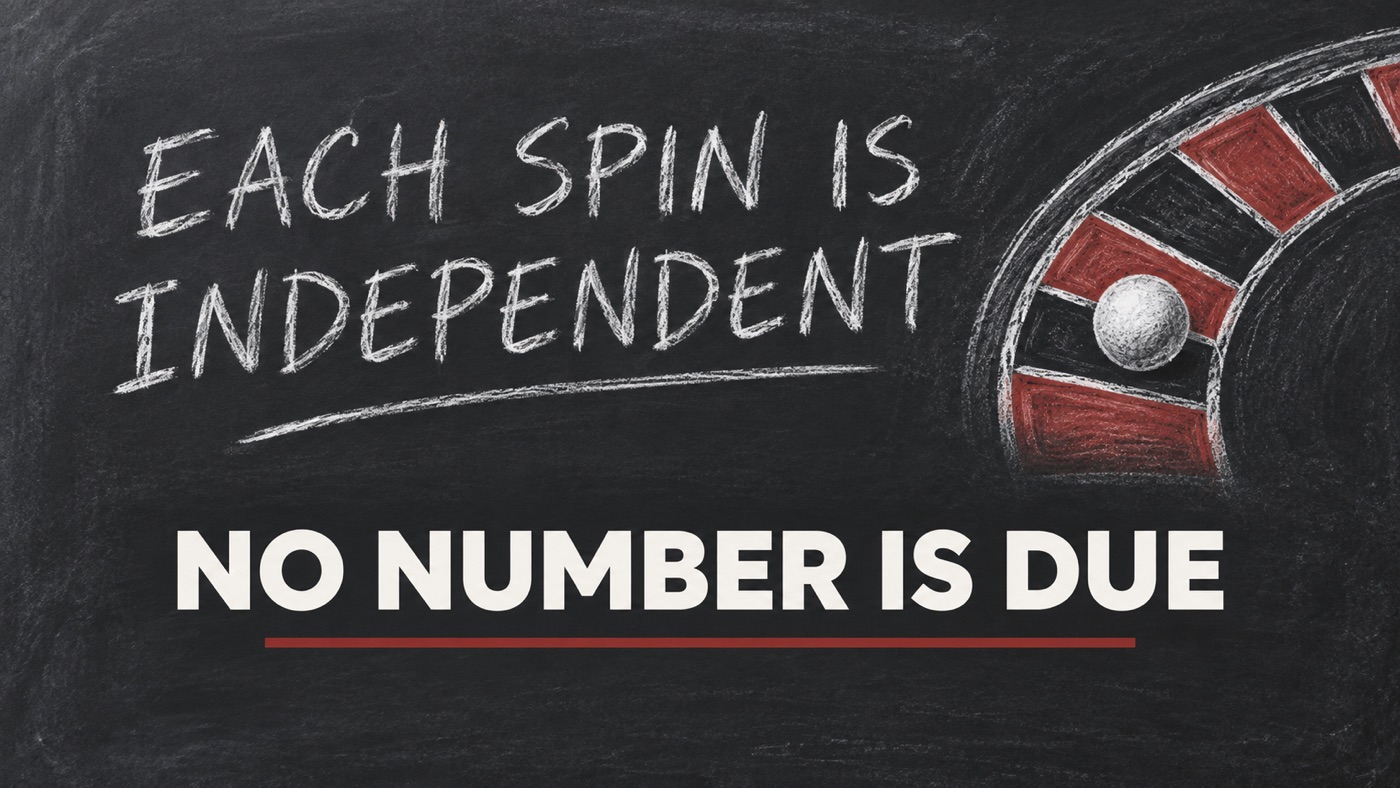
The gambler's fallacy treats a recent pattern as a reason that the opposite outcome must become more likely. In an ideal roulette model with equally likely pockets and independent rounds, ten consecutive black outcomes do not make red more likely on the next spin. MIT's probability course uses roulette to illustrate this distinction between an unusual sequence and an unchanged next-trial probability.
This is a statement about a model. It is not an investigation of a physical wheel, a software system or an operator. Independence and equally likely pockets are assumptions for the calculation, not facts proved by a short results display.
Conditional probability makes the claim precise
On a single-zero wheel with 18 red pockets out of 37, the next-spin red probability is 18/37, approximately 48.6486%. Under independence, the probability of red given ten previous black outcomes is still 18/37. It is not one half because the wheel also contains a zero, and zero is not red.
For a straight-up number, the next-spin probability remains 1/37 even after that number has been absent for many rounds. Independence means the earlier outcomes do not change the distribution used for the next round. Increasing the stake changes the amount at risk and the potential profit, but not the number of winning pockets.
A sequence probability answers a different question
Before observing ten spins, the probability that all ten are black is (18/37) raised to the power 10, approximately 0.0743%. That low number describes a specific future sequence from its beginning. After the ten black results have occurred, they are observed history. Multiplying their probability into the next-red event does not give the conditional next-spin probability.
For comparison, before any results are known, the probability of ten black spins followed by red is (18/37) raised to the power 11, approximately 0.0361%. Dividing that joint probability by the probability of the first ten black results cancels the ten earlier factors and leaves 18/37. This is why a rare history and an ordinary next-event probability can coexist.
Repeated chances do not make the wheel remember
The chance of at least one win over a planned sequence grows as more independent rounds are included. For one number covered on a single-zero wheel, the chance of at least one win in ten rounds is 1 − (36/37) raised to the power 10, approximately 23.97%. That does not change the probability of each individual round, and it does not identify the chance of finishing with a profit.
Our several-spins guide explains that distinction with fixed-stake examples. The calculator reports both per-round probability and the chance of at least one win, so the two quantities remain visible.
Recognize the limits of a pattern claim
A possible biased mechanism would require evidence and a different model. A streak alone does not establish that mechanism or tell you how to exploit it. The same caution applies to a claim that a win is “due.” The fair, independent model provides no balancing force that repays recent losses. If the urge to recover losses is driving continued play, consult our safer gambling resources instead of treating a probability calculation as a recovery strategy.
Sources and checks
- MIT OpenCourseWare: 18.05 class 4 problem-set solutions, independence and roulette · Checked 2026-10-12
- Loto-Québec: roulette game rules · Checked 2026-10-12