
Roulette probability over several spins
Calculate the chance of at least one winning roulette spin, and understand why that is different from finishing a session ahead.
Start with a clearly defined event
A question such as “what are my roulette odds?” needs an event and a time frame. The probability of winning one particular spin is different from the probability of winning at least once in ten spins. Neither number, by itself, gives the probability of finishing a session with a profit. This guide uses an ideal single-zero wheel with 37 equally likely pockets and independent rounds. It describes a mathematical model, not a test of an operator or a prediction of your next result.
Calculate through the opposite event
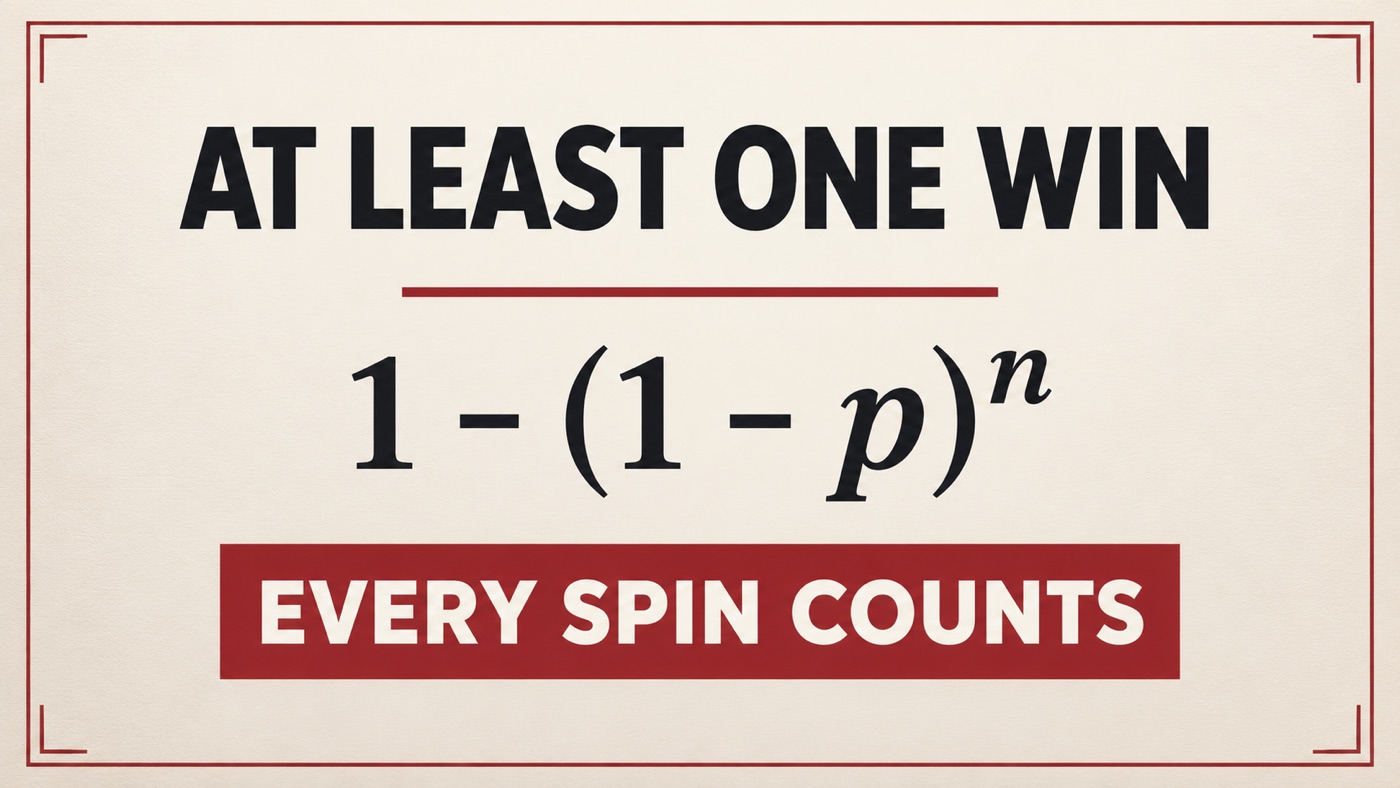
For a straight-up bet covering one number, the probability of a winning spin is 1/37. The probability of a losing spin is 36/37. Under the independence assumption, the probability of losing all ten spins is (36/37) raised to the power 10. The probability of at least one win is therefore 1 minus that number, approximately 23.97%. The same formula works for other numbers of rounds: 1 − (1 − p) raised to the power n, where p is the per-round winning probability.
You can reproduce this result in the roulette calculator by selecting 37 pockets, one number covered and ten independent rounds. The net payout field affects the expected return, but it does not change which pockets make the bet win. That distinction is why probability and payout should be recorded separately.
At least one win does not define the ending balance
Consider ten fixed $10 straight-up bets at a 35:1 net payout. With exactly one winning bet and nine losses, the net result is $350 minus $90, or $260. Now consider 100 fixed $10 bets with exactly one win: $350 minus $990 is a $640 loss. Both sessions contain a winning spin. They do not have the same ending balance.
For the standard single-zero straight-up model, the expected net per $10 bet remains −$10/37. Across ten such bets, expected net is −$100/37, approximately −$2.70. Across 100 bets it is approximately −$27.03. These are averages over repeated modeled sessions, not promises about the result of one session.
Use the independence assumption carefully
Multiplying losing probabilities assumes one spin does not change the next spin's pocket probabilities. A sequence of losses does not make the covered number more likely in that model. Changing stake size also does not change pocket probabilities. A progression changes the amounts won and lost, so the fixed-stake balance examples no longer apply unchanged.
Special wheel rules, side bets, multipliers or unequal pocket probabilities require a different model. Use the calculator to examine stated assumptions, and use the expected-loss guide to keep average return separate from short-session outcomes.
Sources and checks
- Nevada Gaming Control Board: Live Roulette rules and paytable · Checked 2026-10-12
- Loto-Québec: roulette game rules · Checked 2026-10-12