
Prediction Market Order Books: Displayed Price, Limit Orders and Actual Fills
Compare Kalshi and international Polymarket documentation on order execution, partial fills, spread and the difference between a display and an executable price.
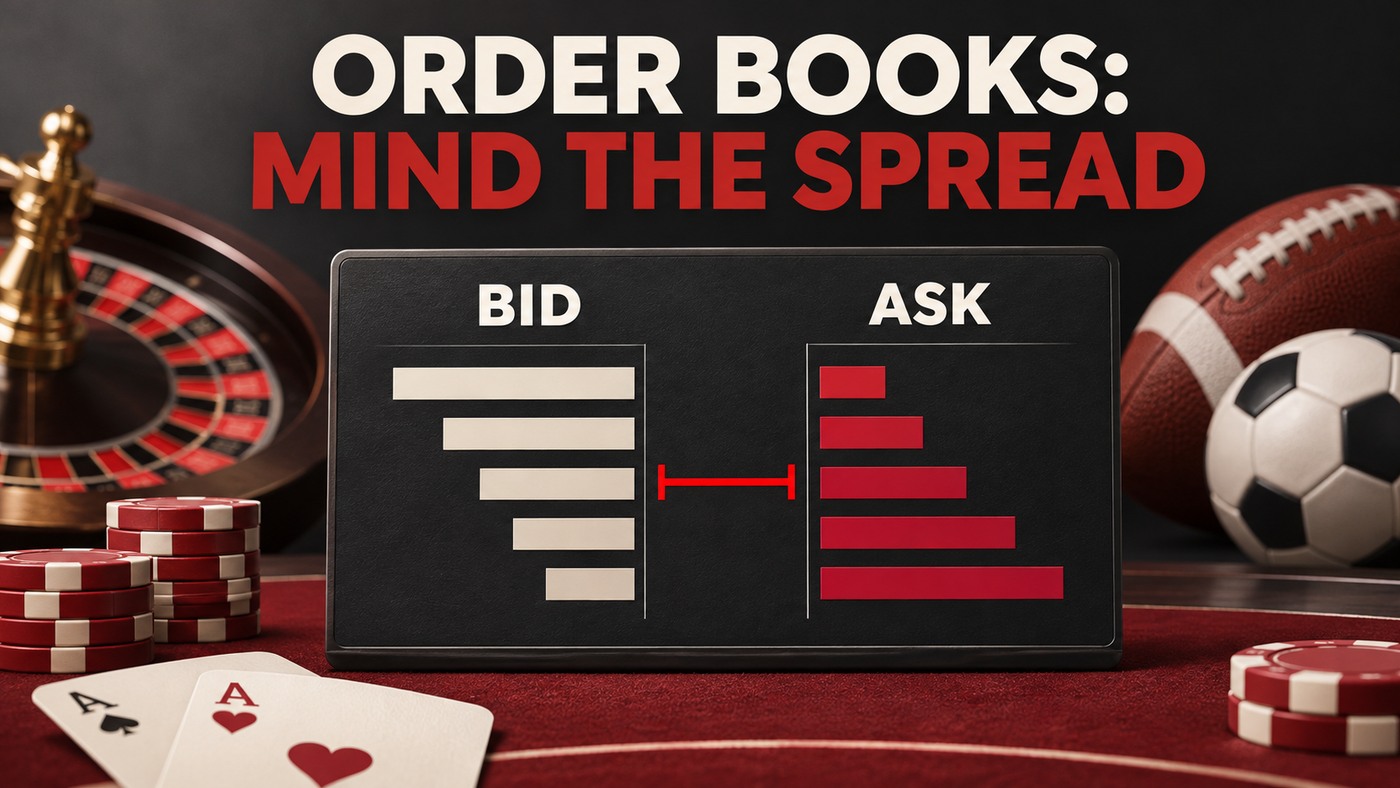
A prediction market’s displayed percentage is not necessarily the price at which an entire order will execute. The best available buy and sell quotes, quantity at each price, order instructions and applicable fees all affect the result. An order book makes those distinctions visible; it does not remove the risk of loss.
This comparison uses official documentation checked November 3,2026. Kalshi help describes its limit orders. The Polymarket material concerns the international CLOB documentation, not an inferred rulebook for a separate US product. Its geographic-restriction page currently lists the United States as close-only for the referenced frontend and API: existing positions may be closed, but new ones cannot be opened through those routes.
Separate the displayed number from the available trade
Polymarket’s Prices & Orderbook documentation describes a central limit order book. Bids are buy orders; asks are sell orders. Its displayed price normally uses the midpoint, with a last-trade fallback when the spread exceeds ten cents. A midpoint is a summary of quotes, not necessarily a resting order available for execution.
| Illustrative book | Price | Meaning |
|---|---|---|
| Highest bid | 46 cents | Best shown purchase offer from another participant |
| Lowest ask | 50 cents | Best shown sale offer from another participant |
| Midpoint | 48 cents | Average of those quotes |
| Spread | 4 cents | Ask minus bid |
These are invented teaching inputs, not a live market. With sufficient quantity and unchanged quotes, buying 100 at 50 cents costs $50; immediately selling them at 46 cents returns $46 before fees. The $4 difference is the spread effect. It is not a separately invoiced execution fee.
A limit sets a price condition, not a fill promise
Kalshi’s limit-order explanation says a purchase limit specifies the maximum price and can remain unfilled. Its sale instructions describe a minimum acceptable sale price. A limit can match immediately if compatible orders already exist; otherwise it may rest. Receiving an order acknowledgment therefore does not establish that all requested contracts were purchased.
Both sets of documentation describe partial fills. If a hypothetical request for 100 contracts matches 30, the executed portion is 30; the other 70 still need their own status checked. Whether an unfilled remainder rests, expires or is cancelled depends on the selected instructions and product. Record the filled quantity and average execution price separately from the submitted quantity.
Immediate execution still depends on depth
Polymarket explains that its market orders are technically limit orders priced to match resting liquidity immediately. Its order-placement documentation distinguishes resting, matched and delayed responses. A larger request may reach several price levels, so the first quote alone cannot price the whole order. Compare available depth and the actual response rather than treating “market” as a guarantee of a single price or complete fill.
Keep three records apart
Record the order instructions, resulting fills and separately charged fees. A resting limit does not automatically mean a fee-free trade; Kalshi’s own help qualifies that discussion with maker-fee exceptions. Our fee comparison covers charges, while resolution covers determination of the outcome. This article explains execution mechanics, without trading either service or recommending a position.
Sources and checks
- Prices & Orderbook - Polymarket Documentation · Checked 2026-11-03
- Place Orders - Polymarket Documentation · Checked 2026-11-03
- Geographic Restrictions - Polymarket Documentation · Checked 2026-11-03
- Limit Orders | Kalshi Help Center · Checked 2026-11-03
- Limit Order Sale | Kalshi Help Center · Checked 2026-11-03