
What game contribution means for wagering requirements
Compare hypothetical 100%, 50% and 10% contribution rates and calculate the actual turnover behind a bonus wagering target.
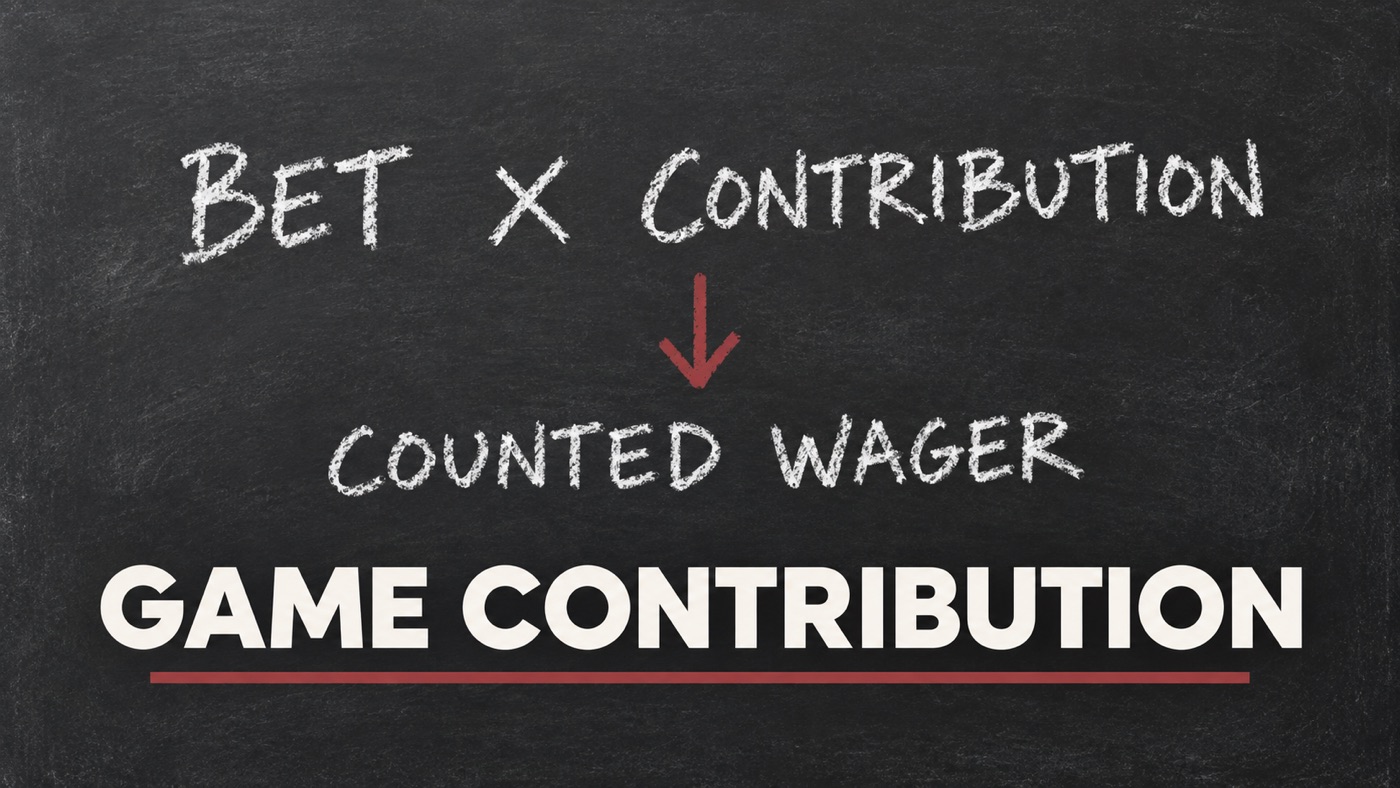
Two totals that should not be confused
A promotion can distinguish the amount you actually wager from the amount credited toward a wagering requirement. Game contribution is the conversion between those totals. This guide uses hypothetical conditions to show the arithmetic. It does not describe an available operator offer, confirm your eligibility or guarantee that any winnings can be withdrawn.
Suppose a $100 bonus has a 40× requirement applied to the bonus alone. The qualifying wagering target is $100 × 40 = $4,000. If every selected game contributes 100%, each dollar of actual turnover credits one dollar toward the target. Completing the target would require $4,000 of actual wagers under that simplified model.
A lower contribution increases the turnover
At 50% contribution, a $10 wager credits $5 toward the target. The same $4,000 target therefore corresponds to $4,000 divided by 0.50, or $8,000 in actual turnover. At 10% contribution, a $10 wager credits $1, and the model requires $40,000 of actual turnover. The promotion's multiplier has not changed. The conversion rate has.
The general formula is actual turnover = qualifying target divided by contribution as a fraction. Entering 50% means using 0.50 in the calculation, not the number 50. At zero contribution, no amount of wagers on that game completes a positive target; division by zero is not a very large valid result. The wagering calculator rejects a zero contribution rate.
The definition of the base still matters
If the same hypothetical terms apply 40× to a $100 bonus plus a $100 deposit, the eligible base becomes $200. The qualifying target becomes $8,000. At 50% contribution, actual turnover becomes $16,000. Before comparing promotions, identify both the eligible base and the game contribution rate. Comparing multipliers alone leaves out these differences.
Bet counts are conditional arithmetic
At a $5 maximum bet, $8,000 of turnover takes at least 1,600 bets if each wager is exactly $5 and contributes at the same rate. Smaller bets increase the count. This does not establish that the starting balance will last for 1,600 bets. Losses, changing balances and an expiration deadline can prevent completion.
Turnover is the sum of wagers, rather than the amount deposited once. Funds can be wagered repeatedly, and the eventual balance can differ sharply from either total. The calculator computes a target and a minimum count; it does not simulate survival of the balance or calculate a cashout probability.
Check conditions outside the formula
Actual terms can exclude games, limit stakes, set a deadline, cap cashout, require verification or define the wagering base differently. Those conditions control the promotion. If different games have different contributions, add their qualifying credits separately instead of applying one rate to all wagers. Read the wagering requirements guide for the broader checklist, and treat every example here as a model to understand rather than a spending goal.
Sources and checks
- Casino Education wagering calculator: disclosed formula and assumptions · Checked 2026-10-02